 |

|
|
January
The year ended, Xmas was enjoyed and presents opened. The world seems unmanageable, certainly here in Greece where we don’t see the end to troubles. Seeing with better eyes is up to Saint Lucia, a Saint admired and esteemed worldwide, particularly in Italy. There is a large icon of St. Lucia in Corfu’s big church, the Agio, but her celebration, on 13 December doesn’t time well with the St. Spyridon major celebration on the 12th - which is a pity. Most icons show her holding eyes on a plate, It is said in the Golden Legend, a nice icon in Washington, from about 1500 with her eyes on a twig, that she herself pulled out then replaced her eyes. Maybe. The name means light. She was venerated right after her death and is the patron saint of ophthalmologists.
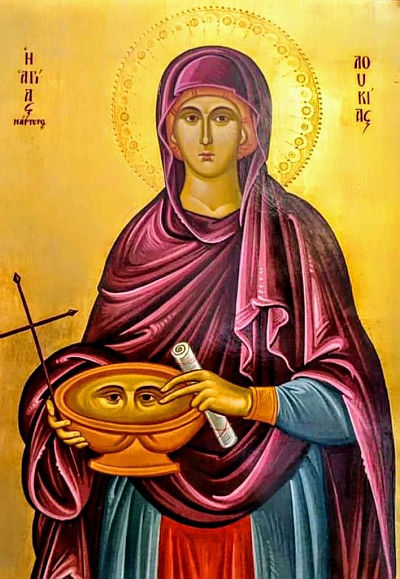
The best book with all the life and many icons of St.Lucia was produced by Apostoliki Diakonia in 2019. There are icons in Venice, Padua, the Prado in Madrid, and in the USA - stressing her life in Syracuse. There are many artists who painted her story like Tiepolo, bringing her fame. The icon in Washington shows St. Lucia holding her eyes on a twig. Quite a story with her martyrdom, stabbed by a sword in her neck, then taking Communion. In a painting, now in Venice, an angel brings her a palm leaf whilst at her feet are the Holy scriptures which she studied and became a saint. The artist Lorenzo Lotto painted her in Venice, showing a white dove as the Holy Spirit. Lucia points out the dove as her protector. It is said that strong animals could not budge her, so determined she was, so full of faith. Do call her if you see things in a fog.
We are all in a fog right now. Did you get your icon of St. Barbara (also painted by Lotto)? These saints from the early centuries had supreme faith, remarkable, not found today. Women chose then to be brave, to cling fiercely to their new faith, to ignore cries from family or suitors. Not a fashion, nor a mode. These women acted alone, no mobile phones, no newspapers or television, which today make or break movements.
January starts off with well known dates, important festivals and songs for the change of year. Housewives make the vasilopita. There are services for the great Antony and for the epiphany - to which we should all go. Don’t forget St. Nina (14/1) - an exceptional, masterful, teacher of the faith and known as a Father of the Church. Worth remembering the festival of St. Ephraim of Syria (28/1). Talks benefitting the soul, all in a small booklet from “Orthodox Kypseli” - talks on how to pray, how to exercise patience, how to deal with the futility of the world, and much more - a great teacher of the Church and a famed ascetic who died around 370 in Edessa. Then the month closes after the day of the Three Fathers (30/1) which school children attend to hear their teacher.
Have a good month and beginning of the new year, praying always for each other.
August 23 - Festival of The Odigitria
As at every monastery, so too at the Holy Metochi, the celebration of the Saint to whom the monastery is dedicated is the most significant day in the year.
In the case of the Metochi, our Patroness is the Holy Virgin and Mother of God, the Odigitria, who in this area is called the Panayiopoula. All year in our thoughts and prayers we call to her to bestow her grace on us.
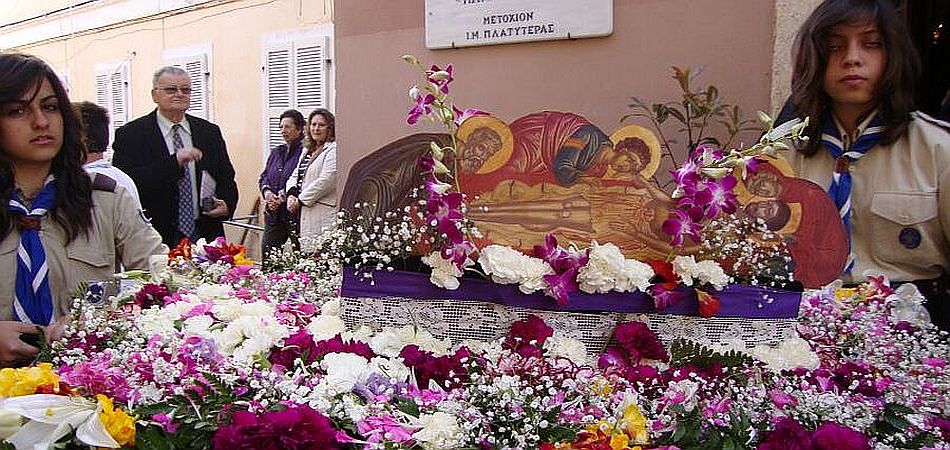
The 23rd of August is the Return Feast of the Dormition of the Virgin Mary, the 9th day, and worshippers venerate a small icon of the Dormition, showing the All-Holy settled on her deathbed surrounded by apostles, hierarchs and angels.
Leading up to the day the church is scrubbed, polished and decorated. The Altar is covered with a richly embroidered cloth only used for this festival, flowers fill every corner and rows of flags are strung up and down the street. The beloved and grace-filled icon of the Panayiopoula is framed in priceless handmade lace.
Celebrating the Panagia Odigitria
The church which so many describe as having a 'soul' is very small, so chairs outside in the quiet street soon fill up with locals and some from further away.
Each Service is officiated by the Hegumen of the Holy Monastery Platytera.
'All generations shall call me blessed' Luke 1, 48.
That is why we call and pray for her help, our Ever-Virgin Mother. All Holy Theotokos intercede for us.
The church can be contacted by writing to PO Box 532, Corfu, 49100 Greece or by email at info@corfu-odigitria.com.
website designed and maintained
by hereford web design